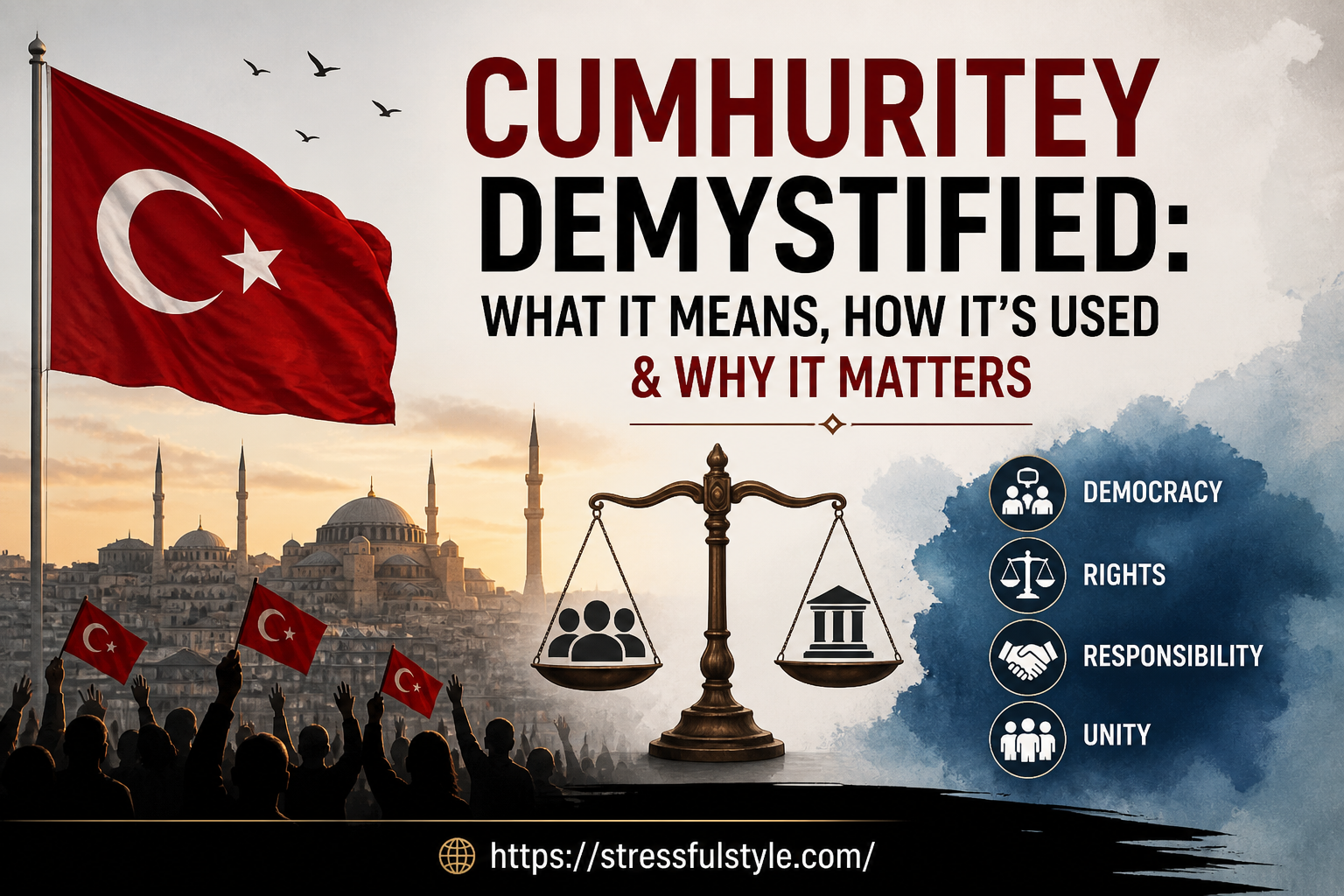
cumhuritey
Cumhuritey is a novel concept that synthesizes issues of governance, citizenship, and cultural identity in Contemporary Turkey. It transcends the traditional connotations of “Cumhuriyet” (republic) and captures how individuals in the present day get on with democracy, participation and social responsibility. In a nutshell, it describes the citizen-state relationship in a more dynamic and evolving context.
In this article, you will discover its meaning and origin, historical context and foundational values, as well as its contemporary implications. You will also discover what makes it different from Cumhuriyet, why it is frequently misinterpreted, and why it is attracting attention in today’s world discussions of today concerning democracy and civic life.
What Is “Cumhuritey”?
Cumhuritey is a contemporary concept representing the relations between people and the state in Turkey today. What “Cumhurriyete EVET” offers beyond the word “Cumhuriyet” (which means republic) is a more active and dynamic concept of democracy.
It examines how citizens enact their rights, participate in decisions and connect with their leaders. At once politically and culturally expressive, it is also a national style.
In effect, Cumhuritey is meant to bridge the gap between traditional systems and today’s rapidly evolving world — motivating people to speak up but also holding authorities accountable.
Origins of Cumhuritey: From “Cumhuriyet” to Modern Usage
The Republic is from the Turkish word “Cumhuriyet,” which means a republic. It’s an idea that originated during a lot of flux in Turkey as it transitioned away from monarchy at the turn of the 20th century and embraced modern democratic values.
This transformation was spearheaded by Mustafa Kemal Atatürk, who sought to create a secular state where people actually had a say in the way they were governed. He thought education and active citizenship were essential in this new system.
The definition has expanded over time, and currently “Cumhuritey” refers not only to a political system, but to cultural concepts, and even the global movement toward democracy, equality, and shared responsibility.
Historical Context: Cumhuriyet, Atatürk & the Birth of the Republic
The “Cumhuriyet” in the title is the Turkish word for “republic,” and it denotes a turning point in Turkey’s history at the dawn of the 20th century. After the defeat of the Ottoman Empire, Mustafa Kemal Atatürk founded modern Turkey and shaped this system within the framework of secularism, democracy, nationalism and modernisation.
His reforms brought profound change to education, law and women’s rights and established a society founded on equality and participation. It was also a cultural revolution as people started to see themselves as citizens actively participating in governance rather than passive subjects.
In its early days, Cumhuriyet was a small and weakly funded newspaper, and over time it evolved into a symbol of enlightenment and freedom; its legacy still has currency in discussions of democracy today.
Hidden Meanings and Interpretations of Cumhuritey
Cumhuritey has a much deeper connotation than just being a term for government or politics. It shows the collective identity and will of a nation-state. To a lot of people, it stands for democracy, responsibility, and the notion that citizens should have a say in how society is run – and that helps bring different groups together.
Still, it does not mean the same thing. Some view it as a marker of social justice and reform, while others associate it more with nationalism and conservative values.
This divergence in interpretation is what makes Cumhuritey a mutable concept with the capacity to be understood differently vis-à-vis each reader and listener, as well as that prompts a reconsideration of the very concept itself in local and global arenas.
Core Principles Behind the Concept of Cumhuritey
The Republic is founded on several key principles that define the nature and function of its society. The first is democracy – citizens are more than mere spectators in the making of government decisions.
Equality is another core value and means that everyone has equal rights regardless of their background, beliefs, or identities, which fosters inclusion and solidarity.
It promotes secularism, which allows for the religion and state affairs to be separated and the best interests of all people to be taken into consideration. Finally, accountability leads the leaders to the public they serve. In combination, these values encourage freedom, justice, and gradual social change.
Who Is Shani Levni? Full Biography, Life Story & Unknown Facts
Seek to Find Thrift Store: How to Find the Best Deals Near You
The Truth About Mebalovo You Should Know
How Studiae Transforms the Way You Learn
How to Use a Blessed Upgrade Scroll
Cultural and Social Dimensions of Cumhuritey
Republic is more than a political concept—it is an expression of values in the Turkish society today, among them democracy, civic participation and social justice. It is very much a cultural thing, closely wrapped in Turkishness (national identity) and conservative-traditional values on one hand, with some moderate modern concepts on the other; and for many to support these ideas is both a duty and a matter of pride.
On a social stage, it has a social aspect as well, and promotes people to engage in the community and public, that help to unite them with the national.
It even raises debates on the rights and responsibilities of citizens, and prompts people to think of their place in the world. Portrayed in arts, literature and film, it is not only political but also emotional and creative identity in Turkey.
Cumhuritey in Modern Governance and Real-World Use
Federalism is being more frequently talked about in the thought of modern governance, especially at a time when democratic principles are under pressure across the globe. It stands for fundamental concepts such as public involvement and government responsibility.
This ideal is implemented in initiatives aimed at enhancing openness in government and enabling citizen participation in governance. Numerous social movements also invoke their ethos in support of equal civil liberties and environmental sustainability.
And policy think tanks, too, co-opt its principles to advocate for democratic reforms and inform citizens in their republican duties and rights. In general, discussions of governance are still being shaped by Cumhuritey, and it is still relevant to those who see value in democracy and citizen participation.
Why Cumhuritey Is Going Viral and Trending in the US
Cumhuritey has started trending recently on the US social media, bringing in curious onlookers seeking a glimpse of worldly notions of democracy and governing. The term defines more than a political framework – it suggests solidarity, inclusiveness, and vibrant civic participation, relating to recurring motifs found throughout US culture.
It’s gaining ground with celebrities and internet personalities who are charged with discussing the ramifications of the term in modern contexts and in analyzing the cultural importance of what democracy could mean in different cultures.
Memes and viral content have also made the topic more popular with young people, who seem to appreciate the humorous twists as they learn educational information. And now, with so many people looking into the Commonwealth to see what international perspectives have in common with their own ideas of democracy.
How Cumhuritey Differs from Cumhuriyet
Cumhuritey and Cumhuriyet may be related terms, but they are not synonymous. “Cumhuriyet” is “republic” and refers to the formal system of government that is democratic, based on the rule of law and citizen rights.
“Cumhurritey” is a larger and cultural concept that surpasses politics. It is more about identity, togetherness and community service. Rather than just institutions, it is about how citizens experience belonging, empowerment and community life.
Over the years, Cumhuritey has become a symbol of collective spirit rather than a mere political structure. Recognizing this distinction gives a deeper understanding of Turkey’s social and political identity and how citizens view their position in society as more than government actors in formal terms.
Common Misunderstandings and Criticisms of Cumhuritey
Cumhuriyet is frequently misinterpreted, especially when it is associated solely with nationalism. National pride is certainly an element of that, but the concept is actually far wider and includes democracy and social justice.
Some critics allege it fosters an exclusive identity and neglects minorities in the country, usually drawing on past societal and political schisms in Turkey. But its backers say the product’s real intent is inclusivity. And there’s a misconception that Cumhuritey is synonymous with authoritarianism, with some citing current political shifts as evidence. Yet many regard the spirit of the times to be a gross misinterpretation.
On the whole, these discussions illustrate how multifaceted Cumhuritey is and how it continues to raise important questions about identity, governance and society in contemporary Turkey.
What Is Beit Bart? Complete Guide with Real Meaning & Usage
What Is Nova Scola? Complete Overview and Hidden Facts
Doujen Moe Meaning: Origins, Culture, and Modern Usage
Christa Podsedly: Biography, Age, Family, and Untold Facts
Lesbufy Explained: Features, Benefits & How It Works
How to Use the Term Cumhuritey Thoughtfully
The use of Cumhuritey needs to be handled with care and awareness of culture since it is laden with historical and social significance. When you say this stuff, always think about who you’re talking to and be sure to indicate that this is not just a normal word, but is one tied to Turkish history and identity. Context is everything when using this term, especially considering Cumhuriyet and its… It’s really developed over time.
To casually use it is to risk its meaning being watered down or misunderstood. No, it’s perfect for dignified debates on democracy, secularism, the good life in the modern age, and society.
It is also crucial to be open to differing opinions, as users may have different interpretations of the term. Hearing and dialogue make the conversations about the community that were more meaningful and balanced.
The Future of Cumhuritey and Why Its Mystery Matters
To the future, Cumhuritey expands and mutates in our various fields of vision. From the term “Cumhuriyet” (republic), it is endowed with concepts that transcend borders and engage in global dialogues concerning democracy, governance, and civic duty. Its enigma is not only its precise denotation: what future generations grappling with matters such as equality, representation, and human rights will make of it.
As they gain momentum globally, so too does Cumhuritey ascend as a beacon of potential unity and positive transformation. Knowing it makes people ask questions — it makes people think a little bit deeper about politics and society instead of just giving them Tags. Ultimately, its significance is that it enables us to question the way we are governed today and to visualize a brighter, more inclusive tomorrow.
FAQS
What is the meaning of the word “Cumhuriyet”?
“Cumhuriyet” is equivalent to the word “republic” in English. A republic is a form of government in which the people select their leaders by voting. In a republic, there is no king or queen ruling. It belongs to its citizens, not a monarch. In Turkey, “Cumhuriyet” is a sign of liberation and equal rights and the people-run country ideal.
Who founded the Republic of Turkey?
Mustafa Kemal Atatürk was the founder of the Republic of Turkey and the first President of Turkey. I do admire a great man who actually did what was necessary to make that happen in Turkey. He formed a new regime based on democracy and national solidarity after the demise of the Ottoman Empire. As a result of his contribution, he is also called the “Father of the Turks.”
Who lived in Turkey before Islam?
Before Islam, there were different tribes of people living in what is now Turkey. These are from ancient cultures (the Hittite, Greek, Roman , etc.). The area was later part of the Byzantine Empire, and the people were mostly Christians. Islam came to the area a few centuries later, and culture and religion changed with time.
What was Mustafa Atatürk’s religion?
Mustafa Kemal Atatürk was born to a Muslim family. However, he was a strong believer in the separation of religion and government. He worked to establish a modern, secular state where citizens could live according to their own faiths. His ambition was unity and progress, not religious domination.
Which prophet was Turkish?
None of them was a Turk. All the prophets in Islam, like Prophet Muhammad (peace be upon him), are from middle east. However, Turkish people are Muslims, and they respect all the prophets greatly. Turkey has a deep history of Islamic culture, even if none of the prophets were from there.
Is Istanbul still Islamic?
Istanbul is not considered an “Islamic city” by any means, but a lot of its residents are Muslim. Turkey is a secular state, which means a separation of religion and state. In Istanbul, you will find mosques, churches and temples. People are at liberty to practice their own religion.
Is hijab prohibited in Turkey?
No, the hijab is not banned in Turkey now. Historically, some restrictions existed in certain areas such as government offices and universities. But those laying down the law have altered. Now women are free to wear hijab, if they want. Turkey is known for giving people freedom in clothing and religion.
About the Author