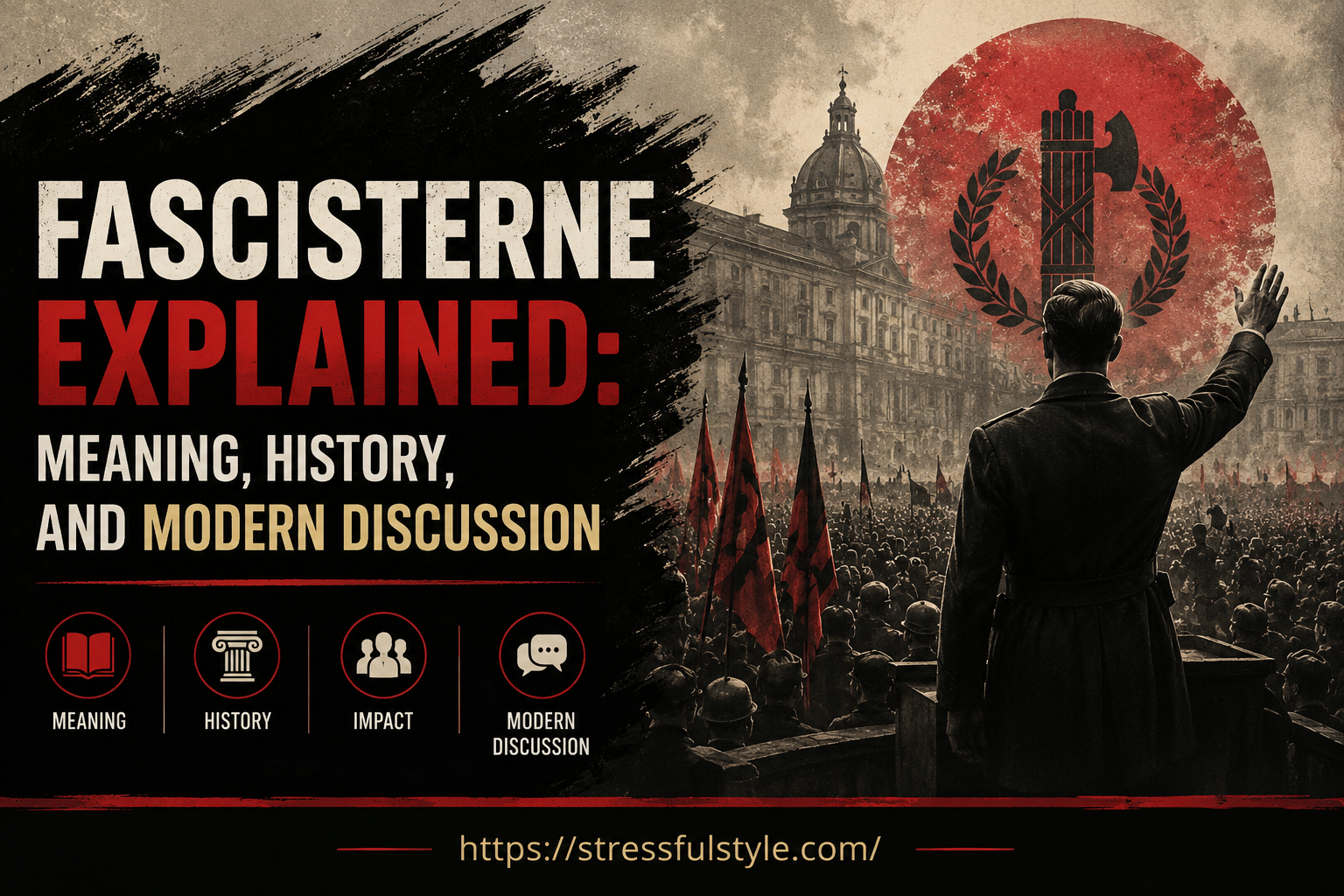
Fascisterne
The word fascisterne is a charge of misrepresentation with a mental picture of oppressive rule, over-the-top nationalism, and ugly periods of history. But from that it is more than. “There is a whole family of ideas and movements that have been relevant in societies of the past and even of today.
To make sense of fascisterne, we have to examine what it is, how it comes about, and the core ideas that make it up. It grew out of the old Europe in an age of emergency, galvanized by certain men who made its thought and its impact. We can even contrast it with other despotic systems to see how it fits in history and contemporary debates.
Studying fascisterne allows us to examine the origins, diffusion, and implications of these ideas in the context of contemporary society.
What Does Fascisterne Mean?
Fascism is a far-right political ideology that paves the way for authoritarian rule, hyper-nationalism, and contempt for the people’s democratic rights. It originated in the late 19th and early 20th centuries as a counter-movement to the increasing popularity of socialism and communism.
Fascisterne places the state above the individual and the culture above unity in cultural diversity, and often speaks harshly or excludes minorities. It creates a stark “us versus them” mentality that can feed into populist gains.
The term is also used to refer to various totalitarian movements in Europe that sought to dominate political, social and economic life and to different totalitarian parties and ideologies that revise social, political and economic life.
Yet, even if these tendencies differed significantly in each country and for each leader, the core ideas remained exactly the same throughout history.
The Origins and History of Fascisterne
Fascisterne was born in the war-weary, economically troubled and socially upheaved Europe of the early 20th century. People had become disillusioned with conventional politics after World War I.
One of the first and most important manifestations was born in Italy about 1919 under Benito Mussolini, who advocated authoritarian government as a means of regaining national strength and unity.
In the ’20s, the ideas went from Italy to Germany, where Adolf Hitler and the Nazi Party took these principles, and turned them into an extremist, fear-based, propaganda, and divisive movement and included racist ideas.
Fascisterne was strongest in crisis, when people were most susceptible to such movements. It was by no means only an Italian phenomenon by the mid-1930s, it had come to dominate much of Europe as a politico majority, not just a movement.
Historical Context Behind the Rise of Fascisterne in Europe
Fascisterne developed from profound social, economic and political instability in the wake of World War I in Europe. A lot of Britons were facing economic ruin, national shame and more public anger than they were used to.
As hyperinflation, unemployment, and privation intensified, more people were lured by extremist politics. Citizens were now seeking strong leaders able to bring order, stability, and national pride.
Fascist movements capitalized on this stage to promise control and regeneration. The Treaty of Versailles also incited anger, in particular among such countries as it affected, and extremism found support through appeals to nationalism.
In this general climate of fear and anxiety, charismatic leaders emerged who answered the anger of the people and preached unity, strength, and national renaissance – leading to the spread of the fascisterne in Europe in the early 1900s.
Core Ideology and Characteristics of Fascisterne
Fascisterne traces strong central power in the form of an authoritarian leader to whom opposition is not tolerated. The state is elevated above the rights of the individual, and the nation is considered the highest good.
It even tends to encourage militarism and expansionism and treat war as a means of national strengthening and “renewal” through strong or territorial objectives.
Another crucial aspect is its emphasis on racial or ethnic purity, often expressed in xenophobic rhetoric which segregates people into ‘superior’ and ‘inferior’ categories, resulting in a very clear ‘us versus them’ mentality.
Loyalty to the state is above all else, and unity is achieved through homogeneity rather than pluralism. Propaganda and symbolism are also present, molding public opinion with a nonstop message and visual cues in order to embed the ideology firmly in day-to-day life.
The Role of Nationalism, Racism, and Totalitarianism in Fascisterne
Nationalism, racism, and totalitarianism, the pillars of fascism, combine to create a compelling and domineering ideology. Nationalism promotes a great pride in one’s country but also in an exclusive manner, which divides people into “us” and “them” and foments hostility towards outsiders.
Racism exacerbates this separation by advocating for racial hierarchies, scapegoating minority populations, and celebrating the concept of ‘racial’ purity. totalitarianism rounds out the system by requiring absolute allegiance to the state, where individual liberties are crushed, and dissension is muffled.
In combination, they produce a tightly controlled society, shaped by propaganda and terror, that stifles pluralism and eradicates dissent—revealing the enduring damage of the fascisterne in history.
Key Figures Associated With Fascisterne
Several prominent leaders are associated with fascism, in particular Benito Mussolini, who, as Prime Minister of Italy, actively propagated and contributed to the spread of fascist ideology in the first half of the 20th century by way of his rhetoric and leadership.
In Germany, Adolf Hitler followed similar notions and went on to establish an extreme nationalist government combined with authoritarian rule.
His rule led to the ruin of Europe with tyranny and endless war. In Spain, Francisco Franco built a military dictatorship based on fascist principles but adapted to Spain’s own political realities.
In like fashion, António de Oliveira Salazar ruled over an authoritarian Portugal with like characteristics. These men were instrumental in establishing and enforcing fascist style rule, and the complex, controversial legacies they left behind are still discussed today.
Read For More Information!
What Is Fkstrcghtc? Full Meaning and Internet Discussion Explained
Pabington Explained: Meaning, Origin, and Online Popularity
Lyposingrass: Meaning, History, and Online Discussion
Crackstreams Explained: What It Is and Why People Search for It
Why Portar Leisa Is Gaining Attention Online
Fascisterne Compared to Other Authoritarian Ideologies
Fascisterne adskiller sig fra andre autokratiske systemer ved en kraftig blanding af nationalisme og militarisme. In contrast to communism, which promotes a classless society, fascism is based on national or ethnic unity and loyalty to the state.
Furthermore, it places great emphasis on a strong, charismatic leader symbolizing national pride, generally establishing a personality-centered system where dissent is not permitted.
In contrast with socialism, which advocates cooperative or public ownership, fascism permits private property. Still, it subjects it to increasingly rigorous state control, so that it is directed to national rather than individual ends.
Although it involves the suppression of opponents as other authoritarian governments do, fascisterne will go to great lengths to propagate, manipulate, and even coerce the public for its own ends, making it more of a mass-driven organization rather than a more autocratic type of organization.
The Rise of Fascisterne Regimes and Their Impact on Society
The ascendance of fascisterne regimes represented a disturbing era in history, arising in periods of economic panic and social upheaval by exploiting public discontent. They offered the promise of stability and national regeneration, but mainly through authoritarian control.
Propaganda was employed to influence public opinion and to depict an idealized image of social life. Once in office, such regimes went on to crush dissent by censorship, intimidation and violence, dictating uniformity in all areas of life.
Their advocacy of militant nationalism and racial superiority broke down the society and created massive human rights violations. The effect on society was devastating, tearing families and communities apart, and enduring well beyond the fall of these regimes, for generations who lived under their rule.
Fascisterne and World War II
Fascists were instrumental in bringing about the Second World War, as nations including Italy and Germany pursued expansionist policies based on nationalist and militarist ideology.
Under the leadership of Benito Mussolini and Adolf Hitler, fascism inspired invasions throughout Europe and the establishment of totalitarian rule in numerous areas. Civilians suffered enormously. Propaganda fosters hatred of the groups so targeted, underpinning genocidal policies such as the Holocaust, in which millions were systematically murdered under fascist regimes.
As the war went on, a coalition of opposing countries banded together to resist and bring down these governments, illustrating a worldwide disapproval of fascisterne’s creed.
Following World War II, the majority of fascist governments were overthrown. Yet, the power and historical significance of these entities continue to shape political conversations well after the conclusion of that conflict.
Read For More Information!
Doujins Culture Guide: How Independent Manga Became a Global Trend
Doujin Moe Explained: Meaning, Origins, and Anime Culture Guide
Nelonium Meaning, Origin, and Internet Discussion
Cartetach Overview: Everything Explained Clearly
Severna Dakota Explained: Everything You Need to Know
The Impact and Legacy of Fascisterne in Modern History
The legacy of fascisterne can still be felt in politics and public debate, where its language has influenced politicians and where far-right movements have drawn inspiration. 0Its memory remains influential in debates on immigration, national identity, and the state in parts of Europe.
There are echoes of authoritarian thinking in some contemporary populist movements, which revives questions over the trade-off between the individual and collective identity.
Teaching now includes a significant focus on the history and ramifications of fascisterne, equipping new minds with the tools to identify extremist ideologies and prevent them from making a resurgence.
Movies, books and other cultural products also keep this history alive by examining it and prompting us to think about power, morality, and our society questions that are just as relevant today.
Modern-Day Discussions and Interpretations of Fascisterne
Iagttag ation today is of fascisterne has rippled widely, in particular on social media, where debates surpass academic circles at a rapid pace. The term is frequently applied in a more generalized way in contemporary political discourse than in the past.
Sometimes activists use it to describe global neofascist groups, converging historical frameworks with contemporary political phenomena. A lot of the right-wing analysis is very preoccupied with nationalism and identity politics and how that stuff can be dangerous in today’s society.
Historians often compare previous regimes with current trajectories, resulting in an ongoing discourse among historians and thinkers.
To be sure, the efforts to raise consciousness are intended to teach younger generations about the perils of fascisterne-like movements, to inspire them to think about democracy and to remind them that they have a duty to protect it in uncertain times.
Lessons the World Can Learn From the History of Fascisterne
The history of fascism holds valuable lessons about power, society, and governance. Among the larger lessons is the imperative to shield democratic institutions, as authoritarian ones frequently emerge in times of crisis, having fed on fear and economic turmoil.
It also demonstrates how we should be wary of hyper nationalism and racism, which always divide us by attacking minorities to “unite” us. Identifying these Tribune patterns is a step toward more inclusive, stronger communities. An education is key to stopping extremist ideologies.
When people know their history, they can promote tolerance, not hate. And it is necessary to keep in mind that authoritarianism can arise within even the most stable democracies, so vigilance and defense of civil liberties are always required.
Through such historical lessons, societies can fashion healthier politic systems, where multiplicity is valued and tyrannical rule is less able to gain purchase.
FAQs About Fascism
What country is an example of fascism?
One of the clearest examples of fascism in history is Italy under Benito Mussolini. During his rule, the government had strong control over people’s lives, and the state was placed above individual freedom. Germany under Adolf Hitler is also often studied as another major example, where similar authoritarian ideas were used.
What is the first example of fascism?
The first well-known example of fascism began in Italy after World War I. It started in the early 1920s when Benito Mussolini came to power. His movement focused on strong leadership, nationalism, and strict control over society. This system later became the model for other fascist movements in Europe.
Is fascism left or right?
Fascism is generally placed on the far-right side of politics. It supports a strong national identity, strict leadership, and limited political freedom. Unlike left-wing ideas, it does not focus on equality or shared ownership. Instead, it emphasizes order, power, and loyalty to the nation.
What are the five main ideas of fascism?
The five main ideas of fascism are strong leadership, extreme nationalism, strict control of society, suppression of opposition, and unity through loyalty to the state. These ideas work together to give the government full power and reduce individual freedom in society.
About the Author