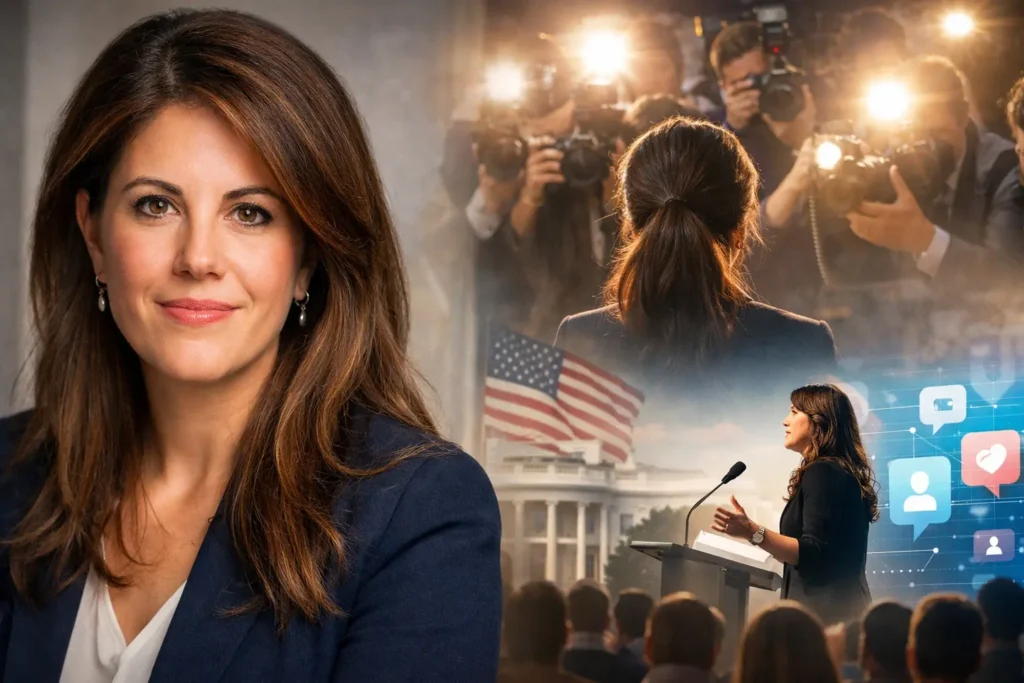
monika leveski
Introduction to Monika Leveski
Some names echo through history not because of greatness chosen freely, but because of a storm that arrived uninvited. Monika Leveski — a name that many search for, sometimes spelled differently — is better known to the world as Monica Lewinsky, a woman whose life became one of the most scrutinized stories in modern American politics and media.
Her journey from a young intern in Washington D.C. to one of the most talked-about women on the planet is not just a story of controversy. It is a story of survival, reinvention, and the very human need to reclaim one’s own identity.
This article is a full and honest exploration of who Monika Leveski really is. It covers her biography, her struggles, her activism, and her remarkable comeback in a world that once tried to define her entirely by her worst days. Whether you arrived here through a search variation, a misspelling, or plain curiosity, you are in the right place.
Who Is Monika Leveski?
Monica Samille Lewinsky, commonly searched as Monika Leveski, was born on July 23, 1973, in San Francisco, California. She is an American writer, speaker, producer, and anti-bullying advocate who gained worldwide attention due to the Clinton–Lewinsky scandal of the late 1990s.
After years of silence and personal struggle, she returned to public life as one of the most compelling voices speaking out against online harassment, cyberbullying, and the destructive power of public shaming.
Her public journey has evolved dramatically — from victim of a national scandal to a confident activist, contributing editor at Vanity Fair, TED Talk speaker, and founder of Alt Ending Productions. Today, Monika Leveski is recognized not for what happened to her in 1998, but for what she chose to do with her story in the years that followed.
Early Life, Family Background & Childhood in California
Lewinsky was born in San Francisco, California, and grew up in an affluent family in Los Angeles, California. She lived in Brentwood, and later Beverly Hills. Her father is Bernard Lewinsky, an oncologist, who is the son of German Jews who emigrated from Germany in the 1920s, first moving to El Salvador and then finally to the United States when he was 14.
Her mother, born Marcia Kay Vilensky, is an author who uses the name Marcia Lewis. In 1996, she wrote a “gossip biography”, The Private Lives of the Three Tenors. Lewinsky’s maternal grandfather, Samuel M. Vilensky, was a Lithuanian Jew, and her maternal grandmother, Bronia Poleshuk, was born in the British Concession of Tianjin, China, to a Russian Jewish family. Lewinsky’s parents divorced in 1988 and each has remarried.
The family attended Sinai Temple in Los Angeles and Lewinsky attended Sinai Akiba Academy, the school affiliated with the Temple. For her primary education, she attended the John Thomas Dye School in Bel-Air. Lewinsky attended Beverly Hills High School for three years before transferring to Bel Air Prep (later known as Pacific Hills School), graduating in 1991.
Following her high school graduation, Lewinsky attended Santa Monica College while working for the drama department at Beverly Hills High School and at a tie shop. Andy Bleiler, her former high school drama instructor, alleged they began a five-year affair in 1992.
In 1993, she enrolled at Lewis & Clark College in Portland, Oregon, graduating with a bachelor’s degree in psychology in 1995.
With the assistance of a family connection, Lewinsky secured an unpaid summer White House internship in the office of White House chief of staff Leon Panetta. Lewinsky moved to Washington, D.C., and took up the position in July 1995. She moved to a paid posting in the White House Office of Legislative Affairs in December 1995.
Education and Personal Interests of Monika Leveski
Monica Lewinsky pursued her undergraduate degree at Lewis & Clark College in Portland, Oregon, graduating in 1995 with a degree in psychology. Her academic interests lay in understanding people — what drives them, how groups form judgments, and why individuals behave differently under social pressure. These were not just intellectual interests; they were deeply personal ones for someone who would later become the subject of some of the most intense public judgment in modern history.
After the scandal and years of working to rebuild her life, she returned to academia, earning a master’s degree in Social Psychology from the London School of Economics. This academic background in behavior studies and group judgment gave her a rigorous intellectual framework to understand what had happened to her — and to articulate it to the world with clarity, humor, and unsparing social awareness.
Her personal interests have always reflected a thoughtful, creative mind. From an early age, she was drawn to visual storytelling, design, photography, and writing — interests that would later find professional expression through her work in media and production.
Move to Washington & White House Years
After graduating from Lewis & Clark College in 1995, Monica Lewinsky moved to Washington D.C. to begin a political internship in the Clinton administration. The opportunity to work at the White House was, by any measure, a prestigious one — a young woman’s dream of stepping into the center of U.S. government and witnessing history up close.
Her White House intern years placed her in proximity to some of the most powerful figures in American public life. The environment was charged with power imbalance in ways that were not always visible from the outside, and Monica, still in her early twenties, found herself navigating a world that was far more complex and consequential than she had imagined. What followed — a relationship with President Clinton — would change both their lives in ways neither could have fully anticipated.
Career Beginnings: From Intern to Public Figure
Monica Lewinsky’s entry into professional life was defined by her White House internship and a subsequent paid staff position in the Clinton administration. Like many young people in Washington D.C, she came with ambition, curiosity, and a desire to be part of something larger than herself. Her career beginnings were promising and full of possibility.
But the relationship she entered into with Bill Clinton, the U.S. President, set into motion a chain of events that would consume the next several years of her life and reshape her public journey in ways she could not control. What began as a private matter became a very public one, and the woman who had arrived in Washington with hopes for a career in U.S. government found herself instead at the center of a national controversy.
Starting a Career in Public Life
After the scandal exploded into the public consciousness, Monica Lewinsky was effectively frozen out of mainstream employment for years. Her name had become synonymous with the scandal itself, and media scrutiny made it nearly impossible for her to begin any kind of normal professional life. She attempted several business work ventures, explored options in fashion and handbag design, and spent time working quietly in the media industry — but each step was shadowed by the weight of what the world believed it knew about her.
It was only years later, with the benefit of reflection, a graduate degree, and the rising awareness around digital ethics and online harassment, that she found her true public voice. Her reentry into public life was not as a political figure or a television personality but as a writer, speaker, and activist — someone who had survived something genuinely terrible and had the tools to explain what it felt like.
The Relationship That Became a Political Scandal
The relationship between Monica Lewinsky and Bill Clinton began during her time as a White House intern and continued after she transitioned to a paid role. It was a relationship characterized by deep power imbalance — she was a young staffer, he was the U.S. President — and the emotional dynamics were complex and consequential for both parties, though the consequences were experienced very differently.
The relationship remained private until Linda Tripp, a colleague, secretly recorded phone conversations in which Monica spoke about the affair. These recordings eventually made their way into the hands of Independent Counsel Kenneth Starr, setting off a legal investigation that would engulf the Clinton administration, lead to impeachment proceedings, and turn Monica Lewinsky into a globally recognized figure almost overnight.
The 1998 Scandal Explained (Facts Without Media Bias)
The Clinton–Lewinsky scandal came to full public attention in 1998 when news broke of the relationship and the subsequent legal investigations. What followed was a media circus of unprecedented scale. The House of Representatives voted to impeach President Bill Clinton on charges related to his public testimony about the relationship — a testimony in which he famously denied that he had sexual relations with Monica Lewinsky.
From a factual standpoint, the key elements of the scandal were: an affair between a sitting U.S. President and a young White House intern; the recording of private conversations without consent; the public testimony of Monica Lewinsky before a grand jury; and the political battle over impeachment that consumed much of Washington and the national attention for much of 1998 and into 1999.
What is often lost in discussions of the scandal is the deeply unequal way in which its consequences were distributed. President Clinton survived politically; Monica Lewinsky did not. She bore the full weight of a national scandal while the more powerful party in the relationship retained his career, his standing, and eventually his legacy.
Media Pressure and Public Shaming
If the scandal itself was damaging, the media coverage that accompanied it was catastrophic. The late-night shows and comedy shows of the era made Monica Lewinsky the punchline of a seemingly endless cycle of jokes. Headlines reduced a complex human being to a single, lurid detail. Newspapers, television programs, and the emerging internet all participated in a coordinated spectacle of mockery and judgment that left little room for nuance or compassion.
The media pressure she experienced was not simply criticism — it was a full-scale campaign of public humiliation that played out across every available platform simultaneously. The media cruelty was extraordinary even by the standards of the time, and it left lasting scars. She has spoken candidly about the psychological impact of being the subject of such relentless attack — the loss of privacy, the reputation damage, the emotional distress that came with seeing her name turned into a cultural shorthand for something shameful.
A Private Life Turned Into Global Media Entertainment
One of the most striking aspects of the Clinton–Lewinsky scandal is how thoroughly it blurred the line between private tragedy and global media entertainment. What should have remained a matter of personal and perhaps legal concern was amplified by internet speed into something that reached every corner of the globe almost instantly — a phenomenon that was, at the time, genuinely new.
The media treated the scandal as a spectacle, not as a story about two human beings. The sensationalism in the coverage was stark: late-night hosts competed for the best jokes, tabloids ran lurid details, and the emerging digital space allowed for a new and particularly vicious kind of public shaming. The narrative bias in coverage heavily favored mockery over understanding, and this contributed to a cultural moment that, in retrospect, revealed a great deal about how society treats women — particularly young women — who become associated with political controversy.
How Public Opinion Changed Over Time
For many years, public opinion of Monica Lewinsky was shaped almost entirely by the initial wave of media coverage — which was, by any objective standard, deeply unfair. She was cast as a villain, a seductress, a scandal-maker. The more sympathetic dimensions of her story — her age, the power imbalance, the fact that private conversations had been secretly recorded — were largely absent from the popular narrative.
The rise of the #MeToo era brought a significant shift. As society began to reckon more seriously with workplace dynamics, gender bias, and media responsibility, the story of Monica Lewinsky was reexamined. Commentators, historians, and ordinary readers began to recognize the degree to which she had been scapegoated and shamed while the more powerful party in the affair escaped with his reputation largely intact. This recalibration of public opinion did not happen overnight, but by the mid-2010s it was well underway.
Information Gain: How Monika Leveski Became the First “Viral Victim”
In her famous TED Talk, titled “The Price of Shame”, Monica Lewinsky described herself as “Patient Zero” of cyberbullying — the first person to experience, on a mass scale, the kind of coordinated online cruelty that the digital age would later make commonplace. This is a powerful and accurate framing.
At a time when most people were still learning what the internet was, Monica Lewinsky was experiencing its capacity for viral destruction firsthand. The speed with which her story spread, the loss of control over her own narrative, and the impossibility of escaping the coverage were all harbingers of patterns we now recognize clearly in social media culture, cancel culture, and viral culture more broadly.
Her story gave the world an early and vivid lesson in the human cost of online shaming — the reputation loss, the emotional pain, the digital judgment of millions — and her willingness to speak about it has made her one of the most important voices in ongoing conversations about digital ethics, online safety, and accountability in the age of the internet.
Psychology of Public Shaming & Media Pressure
Monica Lewinsky’s academic background in Social Psychology gave her a unique lens through which to understand her own experience. In her writing, speaking, and TED Talk, she has drawn on psychology and behavior studies to illuminate the mechanics of public shaming — how it works, why people participate in it, and what it does to its targets.
The psychological impact of prolonged public humiliation is severe and well-documented: it can cause depression, anxiety, post-traumatic stress, and a profound disruption of identity. Monica has spoken openly about experiencing all of these. Her analysis of shame narrative, human behavior, and audience behavior has contributed meaningfully to academic and public discussions about the ethics of online judgment and the responsibilities of both media and individuals in the digital age.
She has also explored the relationship between shame and digital content — how the internet creates permanent records of the worst moments in people’s lives, and how this permanence shapes the way individuals and communities navigate questions of accountability, forgiveness, and empathy.
Life After the Scandal: Reinvention & Growth
Lewinsky’s immunity agreement restricted what she could talk about publicly, but she was able to cooperate with Andrew Morton in his writing of Monica’s Story, her biography which included her side of the Clinton affair. The book was published in March 1999; it was also excerpted as a cover story in Time magazine.
On March 3, 1999, Barbara Walters interviewed Lewinsky on ABC’s 20/20. The program was watched by 70 million Americans, which ABC said was a record for a news show. Lewinsky made about $500,000 from her participation in the book and another $1 million from international rights to the Walters interview, but was still beset by high legal bills and living costs.
In June 1999, Ms. magazine published a series of articles by writer Susan Jane Gilman, sexologist Susie Bright, and author-host Abiola Abrams arguing from three generations of women whether Lewinsky’s behavior had any meaning for feminism.
Also in 1999, Lewinsky declined to sign an autograph in an airport, saying, “I’m kind of known for something that’s not so great to be known for. “She made a cameo appearance as herself in two sketches during the May 8, 1999, episode of NBC’s Saturday Night Live, a program that had lampooned her relationship with Clinton over the prior 16 months.
In September 1999, Lewinsky began to sell a line of handbags bearing her name, under the company name The Real Monica, Inc. They were sold online as well as at Henri Bendel in New York, Fred Segal in California, and The Cross in London. Lewinsky designed the bags—described by New York magazine as “hippie-ish, reversible totes”—and traveled frequently to supervise their manufacture in Louisiana.
Rebuilding Away From the Spotlight
During the years of relative public silence, Monica Lewinsky was not idle. She moved between countries, pursued academic study, developed relationships, and worked quietly in various capacities within the media industry and other fields. The private life she led away from the spotlight was an essential part of her healing — a period of rebuilding that involved education, reflection, and a slow, deliberate process of personal growth.
This rebuilding phase also involved confronting the emotional toll the scandal had taken on her family and relationships. Her parents — particularly her mother, Marcia Lewis, whose own life had been disrupted by the scandal — remained central to her support system throughout.
Education, Reflection, and Personal Growth
One of the most significant steps in Monica Lewinsky’s reinvention was her decision to return to formal education. Her master’s degree in Social Psychology from the London School of Economics was more than an academic achievement — it was a deliberate act of identity reclaiming. By studying the very forces that had shaped her most painful experiences, she transformed her emotional pain into intellectual understanding and ultimately into advocacy.
This period of study and reflection produced genuine personal growth — the kind that only comes from sustained engagement with difficult questions. Her graduate work deepened her thinking about group judgment, digital culture, shame, and the psychology of public opinion, and it gave her the credibility and vocabulary to speak about these subjects with authority.
Writing, Producing & Media Projects
As Monica Lewinsky re-emerged as a public figure, she did so as a writer and producer of considerable creative ambition. She became a contributing editor at Vanity Fair, where her essays combined humor, clarity, and unflinching honesty about her own experiences and the broader cultural forces that shaped them.
She founded Alt Ending Productions, a production company through which she has worked on documentaries and interviews that bring her particular sensibility — a commitment to reclaiming narrative and centering the human dimension of difficult stories — to a range of subjects. Her production work represents one of the most tangible expressions of her reinvention: a move from being the subject of other people’s stories to being the author of her own.
Advocacy Work: Fighting Cyberbullying & Online Harassment
At the heart of Monica Lewinsky’s public life today is her work as an anti-bullying advocate fighting cyberbullying and online harassment. Drawing directly from her own experience as what she has called the first major viral victim, she has dedicated enormous energy to raising awareness about the human cost of online cruelty and advocating for systemic change in how platforms, institutions, and individuals respond to it.
Her advocacy work has included collaborations with organizations like Bystander Revolution and the Diana Award, as well as speaking engagements at schools, universities, and conferences around the world. She has worked with students, educators, and social media users to foster a culture of digital compassion and online safety. She has also engaged with the University of Washington on research related to cyberbullying and its effects.
Her anti-bullying campaigns are grounded in a clear philosophy: that empathy and accountability are not opposites, and that a healthier digital culture requires both. She has been consistent and credible in this message — in part because she has lived it in the most public way imaginable.
TED Talks, Public Speaking & Cultural Impact
Monica Lewinsky’s TED Talk, “The Price of Shame”, delivered in 2015 and viewed millions of times, is widely regarded as one of the most powerful talks in the platform’s history. In it, she spoke candidly about her experience as Patient Zero of cyberbullying, about the psychological impact of public shaming, and about what she sees as the urgent need for a cultural shift in how we treat one another online.
The talk reached a TED audience already accustomed to big ideas, but Monica offered something relatively rare: a first-person account of surviving something genuinely terrible, delivered with grace, intelligence, and a refusal to be defined by victimhood. Its cultural impact was significant — it helped shift the public conversation about online harassment from a debate about policy to a conversation about human dignity.
Her broader work in public speaking has taken her to stages around the world, where she addresses themes including shame narrative, media ethics, gender bias, digital culture, and resilience. Each appearance is a further act of identity reclaiming — a demonstration that she is far more than the scandal that once defined her in the public mind.
Podcasting and Modern Public Voice
In February 2025, Monica Lewinsky launched her podcast, Reclaiming with Monica Lewinsky, which represents her most direct and personal engagement with modern media to date. The podcast allows her to explore themes of vulnerability, identity, resilience, and personal narrative in a format that is conversational, intimate, and immediate.
The podcast reflects the broader evolution of her public voice — from reluctant public figure to confident, purposeful communicator who understands how to use digital platforms and modern communication to connect with audiences in meaningful ways. It also represents a further step in her ongoing project of reclaiming narrative: using her own platform, in her own words, to tell her own story.
Her ability to adapt to modern media — from TED Talks to documentaries to podcasts — speaks to a forward-thinking approach and a genuine understanding of how audience psychology, content creation, and digital strategy intersect in the contemporary media landscape.
Net Worth, Income Sources & Financial Journey
Monica Lewinsky’s financial journey has been as unconventional as the rest of her story. In the years immediately following the scandal, earning a sustainable income was genuinely difficult. Her name was toxic in most professional contexts, and the career struggle was real and prolonged.
Over time, however, her income sources diversified significantly. Today, her revenue comes from a range of sources: speaking engagements at universities, corporations, and conferences; content revenue from her production company Alt Ending Productions; her work as a Vanity Fair contributing editor; brand collaborations and media partnerships; and educational projects tied to her advocacy work against cyberbullying and online harassment. Her podcast, Reclaiming with Monica Lewinsky, adds another dimension to her niche influence and earning potential.
While specific figures are not publicly confirmed, her net worth has grown considerably as her public profile has shifted from scandal-adjacent to respected activist and media figure. Her financial journey reflects her broader personal journey — a slow, hard-won return to stability, influence, and self-determination.
Career Achievements and Recognition
Monica Lewinsky’s career achievements are substantial, particularly given the extraordinary obstacles she has had to overcome. She has been recognized by numerous organizations and institutions for her advocacy work on cyberbullying, digital compassion, and online safety. Her TED Talk is among the platform’s most-watched and most-cited. Her work with Alt Ending Productions has earned recognition in the documentary and media spaces.
She has been honored by organizations including the Diana Award for her work on anti-bullying and youth welfare. Her contributions to public discourse around shame, media ethics, gender bias, and digital culture have been acknowledged by commentators, academics, and advocates across the political and cultural spectrum.
Her story is taught in university courses on media ethics, digital culture, and gender politics. Her name appears in academic literature on public shaming, online harassment, and the psychology of viral culture. This is a remarkable reputation for someone who was, for many years, best known for a scandal.
Social Media Influence and Online Presence
Monica Lewinsky’s social media influence and online presence are significant and carefully managed. She has built a substantial following across platforms by combining sharp wit, genuine vulnerability, and a clear commitment to the values she advocates publicly. Her digital identity is consistent with her broader personal brand: thoughtful, direct, and deeply human.
Her approach to social media reflects her sophisticated understanding of digital strategy, audience psychology, and the complex dynamics of influencer culture. She engages authentically with her community, participates in online discussions around issues she cares about, and uses her platforms to amplify anti-bullying campaigns and other causes.
The performance metrics of her online presence — follower counts, engagement rates, and the reach of her content — reflect her status as a genuine voice in digital culture and a figure of cultural symbolism in conversations about internet behavior patterns and online visibility.
Why Monika Leveski Still Trends Today
The continuing relevance of Monika Leveski — and the persistence of searches under this and related spellings — reflects several intersecting forces. First, there is the enduring fascination with the Clinton–Lewinsky scandal itself, which remains one of the defining political and cultural stories of the 1990s and of U.S. history more broadly. Second, there is the growing recognition, particularly in the #MeToo era, that the story deserves to be retold and reexamined with greater fairness and nuance.
Third — and perhaps most importantly — Monica Lewinsky herself has ensured her continued relevance through consistent, high-quality work. Her TED Talk, her advocacy, her production company, and her podcast have kept her in the conversation in ways that have nothing to do with the scandal and everything to do with the quality of her ideas and the authenticity of her voice.
The SEO trends around her name, including the prevalence of spelling errors like monika leveski, reflect the curiosity-driven searches of a global audience that knows her name but is not always sure exactly how to spell it. This pattern of search behavior is itself a measure of cultural relevance — people are still searching for her because she still matters.
Cultural Impact: Media, Gender Bias & Reputation
The cultural impact of Monica Lewinsky’s story is difficult to overstate. She arrived in the public consciousness at a moment when media was both powerful and profoundly irresponsible in its treatment of women involved in political scandal. The gender bias in coverage of the Clinton–Lewinsky scandal — which blamed and mocked her while largely excusing him — was representative of broader patterns in how media covered women in public life.
Her story has contributed to a long-overdue reckoning with these patterns. The media ethics debates she has helped to spark have had real effects on how news organizations, social media platforms, and cultural institutions think about media responsibility, privacy loss, reputation damage, and the right of individuals to a second chance. Her reputation today as a credible, serious activist and public speaker is itself a kind of cultural statement — a refusal to remain defined by the worst framing of her story.
Lessons for the Digital Age
Monica Lewinsky’s story offers a series of powerful digital age lessons for anyone who uses the internet — which, in 2026, means essentially everyone. She has articulated these lessons with remarkable precision across her various platforms and speaking engagements.
The core lessons are clear: words and digital content cause real harm; online judgment has human consequences; the permanence of digital records demands greater accountability from those who create and share content; and platforms and institutions have a responsibility to protect individuals from coordinated campaigns of online harassment. She has also emphasized the importance of empathy and digital compassion in everyday online interactions — the small choices that individuals make about what to share, what to amplify, and what to leave unsaid.
These digital age lessons are particularly important for students and social media users who have grown up entirely within the culture of viral culture and online communities and may not fully appreciate the human cost of content that spreads beyond its original context.
A Story of Resilience and Identity Reclaiming
At its core, the story of Monika Leveski — Monica Lewinsky — is a story of resilience and identity reclaiming. She was subjected to a level of public humiliation, media cruelty, and online shaming that would have broken most people. The fact that she survived it, rebuilt her life, earned an advanced degree, became a respected activist and public speaker, and continues to contribute meaningfully to public discourse is a testament to extraordinary emotional strength, patience, and consistency.
Her journey is also a story about the reclamation of dignity — the refusal to accept the identity that the media and public opinion had assigned to her and the insistence on defining herself on her own terms. This act of identity reclaiming is not just personally significant; it has cultural symbolism for anyone who has been unfairly defined by a single moment or mistake.
The resilience she has demonstrated is not the cheerful, effortless kind that self-help culture sometimes celebrates. It is the harder, quieter kind — built through patience, honest reflection, and the willingness to keep going even when the world seemed to have already made up its mind.
Personal Life, Relationships & Private Journey
Monica Lewinsky has been deliberately private about her personal life and relationships in adulthood, and this is a choice that deserves to be respected. She has spoken in general terms about the importance of family and close relationships to her recovery, and has acknowledged the toll that media scrutiny has taken on those close to her.
Her private journey has been shaped by the ongoing challenge of maintaining boundaries between public and private life in an era when those boundaries are constantly under pressure. She has navigated this challenge with considerable skill — remaining present and engaged in public discourse while protecting the personal dimensions of her life from the scrutiny that once consumed everything.
What is clear from everything she has shared is that her personal life is characterized by genuine emotional intelligence, deep relationships, and a hard-won appreciation for the things that matter most. These are not abstract values for her — they are the product of lived experience.
Monica lewinsky Net Worth
Monica Lewinsky’s net worth in 2025 is estimated to be 2 million dollars, earned through podcast production, public speaking, and media consulting.
Monica Lewinsky is a media producer, public speaker, author, and podcast host, known for her activism against cyberbullying and her work in media.
Lewinsky’s earnings in 2025 come from hosting her podcast, speaking engagements, writing, consulting for television, book sales, and past endorsement deals, with her production and storytelling work expected to grow.
Is Monica Lewinsky Married
No, Monica Lewinsky is not married. The activist, speaker, and producer has never been married and generally keeps her romantic life highly private. While she actively dates, she has also noted in recent interviews that her plans for starting a family have also changed.
Who is Monica Lewinsky Husband
Monica Lewinsky has never been married and does not have a husband. While the activist, contributing writer, and producer is known to date, she has kept her romantic life intensely private.
Did the Grand Jury like Monica Lewinsky
- Statements of absolution: Several jurors told Lewinsky, “We’ve all fallen short” and reassured her that they forgave her for the affair.
- Emotional support: When Lewinsky grew distraught, some grand jurors offered her personal comfort.
- Mutual appreciation: Touched by the response, Lewinsky tearfully thanked them for opening up “your heart and your mind and your soul” to her.
Conclusion: The Legacy of Monika Leveski
The legacy of Monika Leveski — Monica Lewinsky — is still being written. What is already clear is that it is far richer, more complex, and more admirable than the crude caricature that media and public opinion once imposed on her. She is a writer, speaker, producer, activist, and one of the most articulate voices in contemporary conversations about digital culture, online harassment, gender bias, and the ethics of public judgment.
Her story is a biography of reinvention — proof that even the most devastating public humiliation need not be the end of a person’s story. It is also a cautionary tale about the power of media and the ease with which public shaming can destroy a life. And it is, ultimately, a story of human dignity — the insistence, in the face of everything, on being seen as a full and complex human being rather than a symbol or a punchline.
For those who arrive at her story through a search variation or a misspelling like monika leveski, what they find — if they look closely — is something genuinely worth knowing: a person who has turned extraordinary pain into extraordinary purpose, and who continues to do so with passion, creativity, and grace.
About the Author